organisation
Business conduct forms the basis of how HEMA operates, creates value and works with employees, customers, suppliers and other stakeholders. Acting with integrity, transparency and mutual respect are essential to the success of our strategy and to building trust in HEMA as a brand and an organisation.


scroll down
This means that at HEMA, we make conscious and responsible choices in our day-to-day operations as well as in the structure of our organisation and value chain. In this chapter, we describe how our corporate culture, governance, risk management and due diligence help us to manage risks and capitalise on opportunities in the areas of integrity, compliance and sustainability.
G1 IRO-1
material impacts, risks and opportunities
Our open and ethical corporate culture creates opportunities for HEMA by strengthening collaboration, ownership and trust. This helps to foster employee engagement, build long-term supplier relationships and maintain a positive reputation among customers and other stakeholders.
At the same time, unethical behaviour, such as fraud, corruption, non-compliance with laws and regulations, or a lack of due diligence within the value chain, entails material risks. These could have negative impacts on people and the environment, as well as causing financial loss and damage to HEMA’s reputation. The supply chain also involves inherent risks relating to human rights, working conditions and environmental impacts.
Through targeted policy frameworks, clear lines of responsibility and the implementation of governance, risk management and due diligence processes, we manage these risks and strengthen our long-term value creation.
KPIs and objectives
G1
organisation
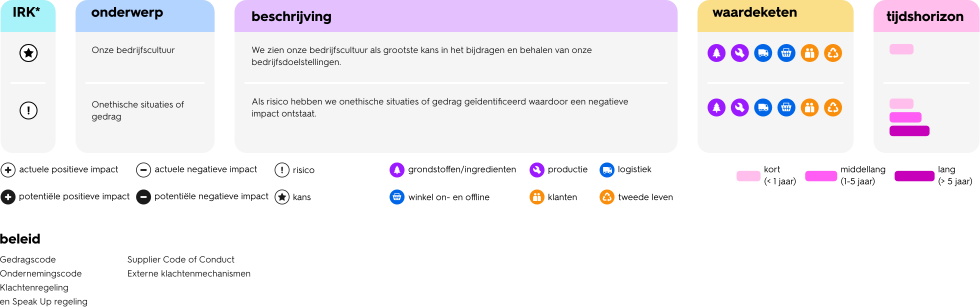
IRK


onderwerp
Our corporate culture
Unethical situations or behaviour
beschrijving
We see our corporate culture as our greatest asset in helping us achieve our business objectives.
We have identified unethical situations or behaviour as a risk that could have a negative impact.
waardeketen


tijdshorizon

current positive impact

current negative impact
risk

potential positive impact

potential negative impact
opportunity
raw materials/ingredients
production
logistics
online and offline store
customers
second life
short (< 1 year)
medium
(1-5 year)
long (> 5 year)
policy
- Code of conduct
- Corporate code
- Complaints procedure
- Speak Up scheme
- Supplier Code of Conduct
- External complaints mechanisms

our culture
At HEMA, good business conduct is reflected in the way we work together on a daily basis. Our culture is characterised by openness, collaboration and a sense of responsibility. Employees are encouraged to take the initiative, share ideas and offer constructive feedback to one another.
We create an environment where mistakes can be discussed and lessons learnt from them, provided this is done in an open and respectful manner. This open communication helps us to spot warning signs in good time and contributes to a safe working environment in which people feel heard and are happy and proud to contribute to HEMA.
code of conduct as a basis
In our working relationships, both internally and with suppliers, we act in accordance with the principles set out in our code of conduct. This forms the basis for ethical, respectful and responsible conduct within HEMA and throughout the entire value chain. Among other things, the code of conduct provides guidelines on dealing with conflicts of interest, gifts and invitations, and makes it clear that corruption and bribery will not be tolerated.
In 2024, a revised code of conduct for suppliers was introduced, with a particular focus on suppliers in high-risk areas. This code sets out mutual responsibilities and encourages coope-ration based on transparency, fair payment terms, capacity planning and production coordination, and emphasises the importance of transparency throughout the supply chain. Read more about the code of conduct for suppliers here.
reports and whistleblowers
HEMA believes it is important that employees and other stakeholders are able to report suspected misconduct safely and confidentially. Reports may relate to breaches of laws and regulations, the code of conduct or other internal guidelines.
Employees can report concerns via HR, their line managers, the compliance officer or anonymously via the ‘Speak Up scheme*’. Whistleblowers are protected against discrimination. The legal department carries out an initial assessment of incoming reports and refers them to the relevant departments, such as HR or Risk & Internal Audit, in order to find an appropriate solution.
External confidential advisors submit an anonymised report each year. This provides insight into the nature and scale of reports and helps us to identify patterns and implement improvements.
*The Speak Up complaints procedure is currently only in place in the Netherlands.
the role of our board in business dealings
HEMA’s management team is responsible for the strategy and its implementation. At HEMA, we value integrity, respect and trust: from how we work together to how we make decisions. With clear management, openness and room for initiative, we are building a HEMA that everyone is proud of.
The Supervisory Board has an Audit Committee, which also oversees the internal control system and risk management, as well as the integrity and quality of financial and non-financial reporting and the financial and non-financial reporting process.

managementteam

Saskia Egas Reparaz
CEO (executive board)

Jurriaan Pouw
CFO (executive board)

Machiel Lagerweij
COO
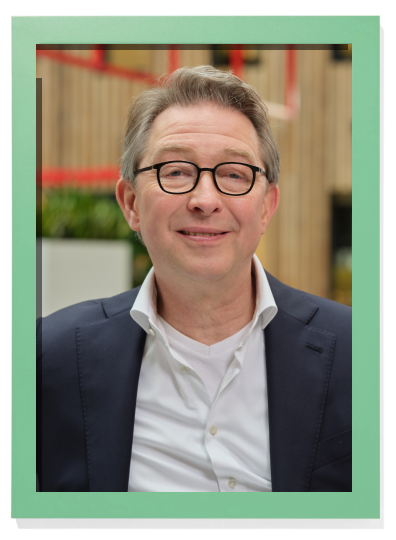
Bas Verheijen
CCO

Pieter Heij
CTO
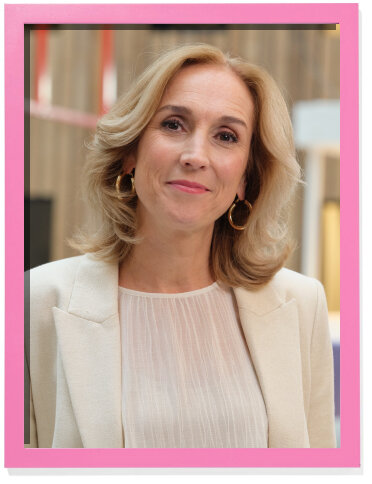
Filippien Wagenmakers
CPeO
sustainability team

Marieke Doolaard
director of sustainability

Annefloor Alting
sr. sustainability specialist (supply chain)

Milou America
sr. sustainability specialist (environmental impacts)

Fuusje Schlette
sustainability specialist
Demi Coenraads
jr. sustainability specialist
departments involved
Other departments involved, such as legal, procurement and quality, have a designated sustainability specialist.
ESRS 2 GOV-1 GOV-2
governance and organisational structure
HEMA operates a two-tier governance structure, comprising an Executive Board and a Supervisory Board, both of which are accountable to the shareholders. The Board of Directors has overall responsibility for the day-to-day management of HEMA and is supported by the management team, which is responsible for the organisation’s strategy, policy implementation and operational management.
executive board
The executive board constitutes HEMA’s statutory management and consists of the Chief Executive Officer (CEO) and the Chief Financial Officer (CFO). Sustainability is a key component of the organisation’s strategy: the CEO has overall responsibility for the sustainability policy and its implementation.
management team
The management team consists of the CEO, CFO, Chief Commercial Officer, Chief Operations Officer, Chief Technology Officer and Chief People Officer. The division of responsibilities is structured in such a way that strategic direction, operational delivery and customer-focused offerings are well aligned.
read more about our structure
governance and organisational structure
HEMA operates a two-tier governance structure, comprising an Executive Board and a Supervisory Board, both of which are accountable to the shareholders.
The Board of Directors has overall responsibility for the day-to-day management of HEMA and is supported by the management team, which is responsible for the organisation’s strategy, policy implementation and operational management.
diversity within the management team and their teams
The executive team (board of directors and management team) comprises two women and four men, with a diversity ratio of 33%.
By 2025, 56%* of the management team and of the managers who report to a member of the management team (in paid employment) will identify as women. Last year, this figure was 53%.
* Data in 2025 is presented based on the accounting policies and definitions described below and is subject to a limited assurance engagement under NV COS 3000. We refer to page 118 for the auditor's Limited Assurance report.
methodology and assumptions
The members of the leadership team who identify as women, as at reference date 31 January 2026. The leadership team at HEMA is defined as follows: ‘all positions held by a member of the executive board within a management team’.
We only look here at employees employed by HEMA, so external employees are not part of the scope. While a number of positions report to a board member on reference date, positions do not qualify as managerial.
To calculate the KPI, a list was made of all employees and the manager. Based on manager, taking into account the above exceptions, the list of leadership was compiled and then the gender ratio was calculated.
supervisory board
The supervisory board oversees the executive board and the general conduct of business within HEMA. In addition, the board provides advice on strategy, operational performance and governance. 40% of the members are independent members.
An Audit Committee operates within the super-visory board. This committee supports the over-sight of the integrity and quality of financial and non-financial reporting, the financial and non-financial reporting process, compliance with CSRD regulations, the internal control system and risk management, and advises on the appointment of HEMA’s external auditor. The current members of the Audit Committee are Ronald Latenstein van Voorst and Ronald van der Vis.
remuneration
Individual agreements have been reached with the management team regarding fixed remuneration. For the fixed salary, pay scales have been established within which salaries can increase. Based on the annual appraisal, the salary may increase up to the maximum level of the relevant pay scale. Compensation for termination of employment is determined on a case-by-case basis.
The variable remuneration for the management team is dependent on performance versus the company’s targets. In case of underperfor-mance, the right to the variable remuneration lapses. All employees are covered by the compulsory Retail Industry Pension Fund. As such, the management team is affiliated to the same pension scheme as all other employees.
management team
(incl. executive board), 1 February 2026

Saskia Egas Reparaz (executive board)
CEO
start date: 1 June 2021
gender: Female
Previously, Saskia was CEO of drug store chain ETOS and a member of the European leadership team at Ahold Delhaize.

Jurriaan Pouw
(executive board)
CFO
start date: 1 April 2022
gender: Male
Before HEMA, Jurriaan worked in various management positions in retail as CFO at C1000 and e-commerce manager at Jumbo.
Machiel Lagerweij
COO
start date: 1 August 2021
gender: Male
Machiel has worked at companies such as De Bijenkorf and MS Mode. Before joining HEMA in 2021, he had several long-term tenures at HEMA.
Bas Verheijen
CCO
start date: 1 June 2021
gender: Male
In his career, Bas has worked at Albert Heijn, C1000, Blokker and Picnic, among others.
Pieter Heij
CTO
start date: 1 June 2021
gender: Male
In his career, Pieter has worked at De Bijenkorf and the Selfridges Group, among others.
Filippien Wagenmakers
CPeO
start date: 1 October 2022
gender: Female
Filippien has held various positions in retail at Ahold Delhaize and Gall & Gall.
supervisory board
1 February 2026
Pieter Haas
Chairman appointed in accordance with HEMA Works Council's right of recommendation
start date: 1 February 2021
gender: male
An experienced executive specialising in digital transformation within the retail sector. Between 2001 and 2018, he held various board positions at Ceconomy, MediaMarkt Saturn Retail Group and METRO AG, where he served as CEO of Ceconomy / MediaMarkt Saturn Retail Group from 2013 to 2018.
Bas Becks
Parcom supervisory board member
start date: 1 February 2021
gender: male
end date: 11 February 2026
A partner at the leading Dutch investment firm Parcom, which has invested in more than 130 (international) companies since 1982, and previously served as Managing Director at CVC Capital Partners and as a strategy consultant at McKinsey & Company; he studied International Business at Maastricht University and obtained an MBA from INSEAD.
Ronald van der Vis
Independent supervisory board member & member of audit committee
start date: 1 February 2021
gender: male
An experienced director with 20 years’ experience as CEO at various companies, including Esprit, GrandVision and Koninklijke Ahrend, and has served since 2013 as chairman of the supervisory boards of Mediq and Basic-Fit and as a non-executive director at Douglas and Beter Bed.
Colette Cloosterman-van Eerd
Supervisory board member
start date: 26 May 2025
gender: female
As a new member of the supervisory board, Colette brings with her extensive retail experience and in-depth knowledge of brand development, entrepreneurship and family businesses. Co-owner of the family-run business Jumbo Supermarkets, and has held managerial and supervisory roles within various retail and consumer-focused organisations.
Ronald Latenstein van Voorst
Independent supervisory board member & member of audit committee
start date: 26 May 2025
gender: male
As a new member of the supervisory board, Ronald brings a strong background in financial services, transformation and governance; he was previously CEO of SNS Reaal and has held various non-executive and advisory roles across a range of sectors.
ESG committee
HEMA’s management is responsible for the company’s strategy, in which sustainability is a key priority. All sustainability issues and preparations for the CSRD are discussed at the ESG committee’s monthly meeting. In attendance are the CEO, CFO, CCO, CPO, and representatives from the communications, legal, procurement, risk and internal audit departments.
CSRD project group
In 2025, we continued to work with a multi-disciplinary CSRD project group to ensure the timely and effective implementation of the CSRD. The project group operates on a project basis and comprises the CFO, representatives from corporate finance, data & analytics, the sustainability team and the risk management team. Chaired by the CFO, the project group is responsible for decision-making regarding HEMA’s CSRD roadmap and monitors progress. The group meets monthly.
stakeholder engagement
The board (MT and SB) are involved and present at stakeholder consultations. The MT as a whole attends strategy days (employees, suppliers), stakeholder meetings (colleagues, NGOs, cooperation partners) and other contact points with internal and external stakeholders. Feedback from these consultations is continuously taken into account in shaping the sustainability policy.

ESRS 2 GOV-4
due diligence statement
We follow the OECD guidelines on due diligence in the areas of human rights and the environment. In doing so, we apply the six steps of due diligence to organise and manage our operations and value chain in a responsible manner.
Our due diligence statement reads as follows
We follow the OECD guidelines on due diligence in the areas of human rights and the environment. In doing so, we apply the six steps of due diligence to organise and manage our operations and value chain in a responsible manner.
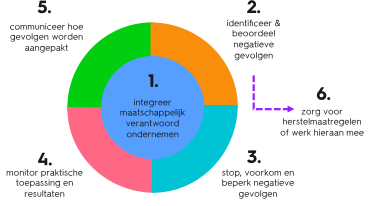
integrate corporate social responsibility
Sustainability is an integral part of HEMA’s strategy. We have established policies and systems that guide our actions on environmental, social and governance issues and are aligned with the CSRD requirements. This policy is underpinned by clear procedures that apply throughout our value chain. We publish these policy frameworks and review and update them regularly.
identify and assess negative consequences
We identify risks relating to human rights, working conditions, the environment and corruption. We do this through risk analyses, internal assessments and by working with external experts and stakeholders. This gives us an insight into where the greatest risks and opportunities lie.
stop, prevent or limit negative consequences
Based on these analyses, we take targeted measures. We prioritise risks based on their severity and the possibility of recovery. This may involve implementing improvement programmes with suppliers, encouraging more sustainable working practices, or supporting initiatives that contribute to positive social and environmental outcomes.
track and monitor implementation
We regularly monitor whether our measures are having an effect. We do this through a range of measures, including internal and external audits, dialogue with stakeholders, and the measurement of environmental and social performance. Where necessary, we refine our approach and draw up improvement plans, the implementation of which we monitor closely.
communication and reporting
HEMA places great importance on transparency. We regularly report on our policies, progress and results in the area of ESG. We do this both internally and externally, including through our sustainability report. In addition, we organise annual meetings with stakeholders to discuss developments and gather feedback.
complaints mechanism and remediation
We have accessible complaints mechanisms in place for employees, suppliers and other stakeholders. Reports are dealt with carefully and promptly. Where negative consequences have arisen, we take appropriate remedial action and work to prevent them from happening again.
Through this structured approach, we ensure due diligence is exercised throughout the value chain. In this way, we minimise negative impacts and contribute to sustainable development, in line with the OECD Guidelines.
ESRS 2 GOV-5
risk management
For HEMA, risk management is an integral part of doing business. It enables us to both create and protect value. We focus on the risks associated with implementing our strategy in the short, medium and long term. When making important decisions, we identify the risks and weigh them up carefully. We identify risks at an early stage, assess their potential impact, implement control measures where necessary, and monitor their development on an ongoing basis. Our established risk appetite forms the basis for this.
organisation and risk management
To keep risks under control and ensure robust internal controls, we have structured our risk management as follows:
- a specialist ‘Risk & Internal Audit’ department that carries out risk analyses and conducts independent audits of critical processes;
- second-line teams, including those responsible for privacy, information security and safety, which manage risks and ensure compliance with laws and regulations in all countries where HEMA operates;
- internal control frameworks covering areas such as finance, cyber security and IT;
- a fixed planning and monitoring cycle comprising a multi-year plan, annual budgets, regular forecasts and management reports;
- established procedures and guidelines for financial policy, including a clear authorisation and procurement policy;
- a whistleblower scheme that allows for the anonymous reporting of suspected misconduct;
- a cyber strategy, supported by monthly meetings of the Information Security and Privacy Committee.
monitoring and reporting
The executive board and the Risk & Internal Audit department report regularly to the Audit Committee on the functioning of risk management and internal controls. Sustainability issues are an explicit part of this. The follow-up to internal and external audit findings is discussed on a quarterly basis. Risk management provides independent insight into the effectiveness of our control measures.
risk appetite
In 2022, HEMA established its risk appetite. We review these twice a year and update them where necessary. In this way, we maintain a healthy balance between entrepreneurship, financial prudence and the creation of long-term value.
Our risk appetite is clear: “Generally speaking, we accept limited risks.” “When it comes to reputation, cybersecurity, product safety and compliance, we deliberately opt for a risk-averse approach.”
key risk areas
Through our risk management process, we identify risks and opportunities at an early stage and monitor them continuously. We have grouped the key themes into three categories: strategic, operational, financial and compliance.
monitoring, results and objectives
HEMA monitors business conduct and integrity using a range of tools. Although specific KPIs have not yet been established for all aspects, we record the number of reports received through our reporting procedures, incorporate business conduct into onboarding and training programmes, and actively inform employees about the Speak Up scheme.
Specific measures are being implemented to prevent corruption and bribery. In 2025, no final convictions were handed down by the courts for breaches of anti-corruption and anti-bribery legislation, and no financial penalties were imposed. These findings confirm that the measures and procedures put in place contribute to acting with integrity and responsibility.
Over the coming years, our objectives will focus on further strengthening our corporate culture, ensuring robust governance and risk management, enhancing due diligence throughout the value chain, and increasing transparency regarding ESG performance and business conduct.
strategic
- Reputation
- Sustainability, ESG and the CSRD
- Competitive position
- Adaptability and innovation
operationeel
- Cybersecurity and privacy
- Product and food safety/quality
- Business and IT continuity
- Recruitment and retention of staff
finance and compliance
- Non-compliance
- Economic and geopolitical situation
- Internal control environment


basis for reporting

ESRS 2 BP-1 BP-2
basis for reporting
This sustainability report covers the period from 3 February 2025 to 1 February 2026. In this report, we provide an overview of our non-financial performance and working practices. We report clear, consistent and comparable information that is relevant to the decision-making of our key stakeholders. We are taking targeted steps to align our reporting as closely as possible with the ESRS.

consolidation
The report has been prepared on a consoli¬dated basis, with the same scope as the consolidated financial statements. This means that the information in this report relates to HEMA as a whole, including all its subsidiaries.
For some measures, we report solely on our largest region, the Netherlands. Where applicable, we will state this explicitly.
value chain
To provide a clear picture of the key impacts, risks and opportunities relating to HEMA, we have included information on our (upstream and downstream) value chain where relevant and where available. This is in line with the findings of our dual materiality analysis.
estimates and assumptions
For some of the sustainability information, we use estimates and assumptions, for example where direct measurement data is not (yet) available. As a result, actual results may differ from previous forecasts. In the notes to the financial statements, we explain the principles applied.
time horizons
Unless otherwise stated, we use the following time horizons:
- Short term: within one year of the reporting date
- Medium term: one to five years
- Long term: more than five years
changes compared with previous sustainability reports
Since 2001, HEMA has published annual sustainability reports. These were initially drawn up in accordance with the guidelines of the ‘Global Reporting Initiative’ (GRI) and complied with the GRI Standards Core level, and with the GRI Standard revision in 2021 ‘relating to’.
Since 2023, we have been gradually aligning our reporting with the ESRS guidelines. In addition, we have updated our reporting in the following areas since the 2023 financial year:
- Material issues determined on the basis of the dual materiality principle.
- A structure aligned with Environmental, Social and Governance principles.
- Additional data points, both qualitative and quantitative, relating to our material topics.
Where there are significant changes to the preparation or presentation of the sustainability information, we explain this as follows:
- We describe what changes have been made and why.
- We adjust comparative figures where possible.
- If the adjustment is not feasible, we will make this clear.
- We explain the impact of the change.
other legislation and regulations
Where relevant, we have also included informa-tion in this report based on other recognised sustainability standards and legislation. These are listed by topic to provide a comprehensive and coherent overview of our sustainability performance.